Plenty of AI projects look great in the demo. Everyone nods. Someone claps. Three months later the tool sits untouched. Nobody's using it. Nobody remembers how to change it. The one person who understood it left, or got moved to another job, or just stopped bothering. That's not really an AI problem. It's an ownership problem, and it's avoidable if you build the right way from the start.
We work with owner-run businesses, usually 10 to 70 staff, and we build every tool the same way: with someone on the client's own team. Not IT. Not whoever's keenest on computers. Whoever actually knows the job and wants to make it better. Here's why that matters, and what it looks like once it's done.
Why it stalls when it's handed to the wrong person
The instinct is to hand AI projects to IT, or to whichever member of staff is most comfortable with computers. It feels logical. It's usually a mistake. IT knows systems. It doesn't know why a quote gets priced the way it does, or why a job sheet needs a certain photo before it counts as finished. That knowledge lives with the people doing the job every day.
Hand it to IT or to one keen person in the office and the tool ends up built around what's technically neat rather than what the business actually needs. Then that person leaves, or gets pulled onto something else, and nobody's left who understands it.
You don't need to be technical. You need to know the job
A lot of owners assume they need somebody technical to make this work. They don't. The person running it needs to know the job and be curious about improving it. That's the whole requirement.
We help pick the right person, then train them and the wider team on the tasks they actually do, in the tools they'll actually use. Their invoicing. Their quoting. Their job sheets. Not a generic tutorial. Nobody's left guessing once we've gone.
What ownership actually means
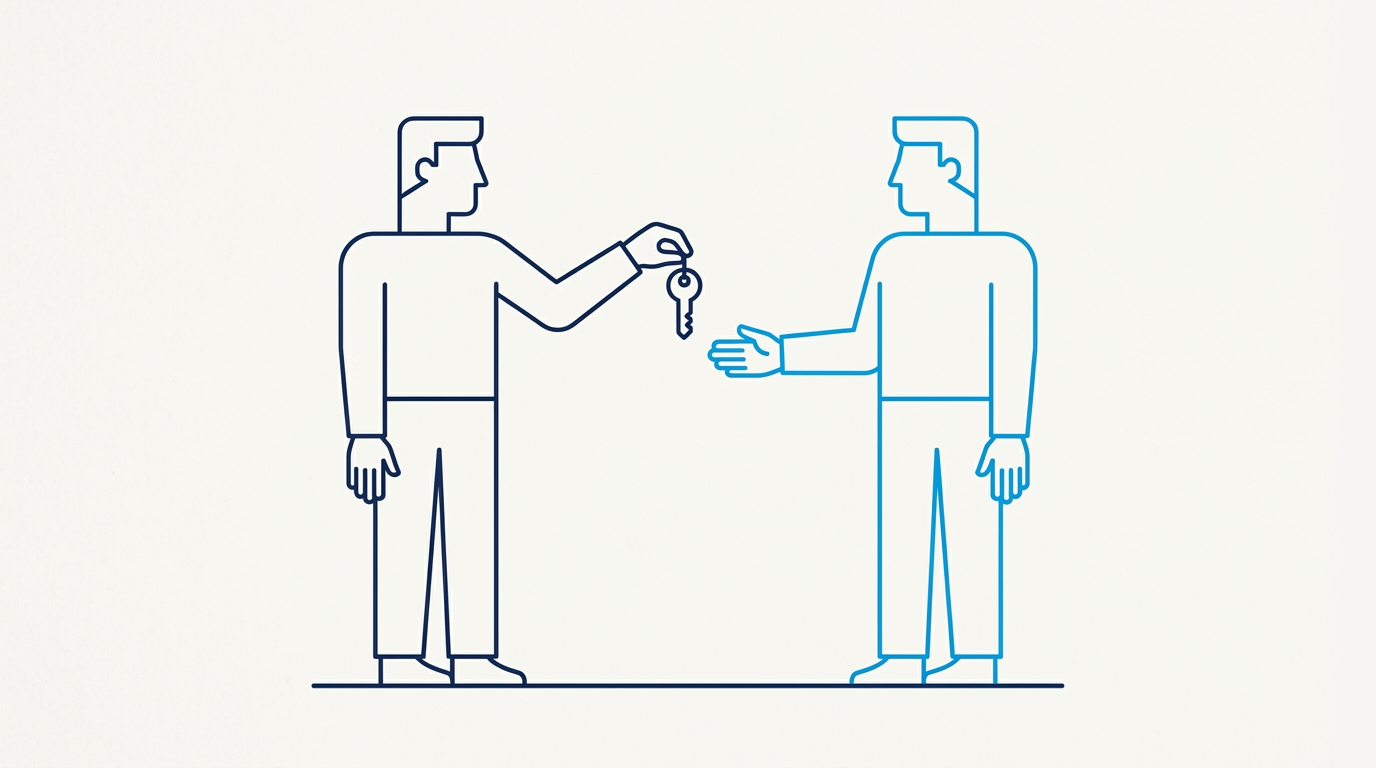
"Who owns it" sounds like a legal question. In practice it's a practical one: if we disappeared tomorrow, could you still run it, fix it, and change it?
Everything specific to your business is yours. Your data, your rules, your settings, your workflows, the connections into your other systems. None of that sits with us. We keep the underlying toolkit we bring to every job, the parts that aren't specific to any one client, and you get a permanent, free licence to use it. That's what stops you being locked into us. You're not paying rent on your own tool.
We stay until you don't need us
We don't build something and vanish. We stay while your person learns to run it, checking it's actually being used and fixing what breaks. We're also watching for the quieter failure mode: quality drifting downward slowly enough that nobody notices until a customer does.
With one client, we didn't call the handover done until their person could do four things without calling us: change a fee rule, add a new job type, work out why a quote had come out wrong, and knew exactly who to call if something broke. That's a reasonable bar for any handover, not just theirs. If your team can't do those things yet, the project isn't finished, whatever the demo looked like.
If you'd rather we kept running it
Some clients would rather we look after the tool long term instead of taking it in-house straight away. That's a fair choice, and it's priced as ongoing support rather than a one-off build fee. It includes hosting and AI usage up to an agreed monthly limit, a monthly quality check so drift gets caught early, fixes at no extra cost, and up to two hours a month of small changes like updating a rule or adding a job type.
It doesn't include new features or anything past those two hours, which we'll always quote for separately rather than just running the clock. Unused hours don't roll over, and usage above the agreed limit is charged at cost, with a warning before you get near it. The arrangement runs for a minimum of six months, then rolls on a month's notice, and you can switch to owning it outright at any point. We train your person and hand it over for a one-off fee whenever you're ready, not on our schedule.
Why this matters more than the tool itself
It's tempting to judge an AI project by how good the demo looks. That's the wrong measure. The right one is what happens in month four, when the novelty's worn off and the person who built it has moved on to the next client. Does it still work? Can your team still change it? Or has it quietly become one more thing nobody's allowed to touch?
Build it with your own people from the start and that question answers itself. Build it around one clever supplier or one keen employee, and you've just moved the risk from "the process lives in the owner's head" to "the tool lives in someone else's."
Talk to us if you want an AI tool your own team can actually run, not one you're stuck renting back from whoever built it.