
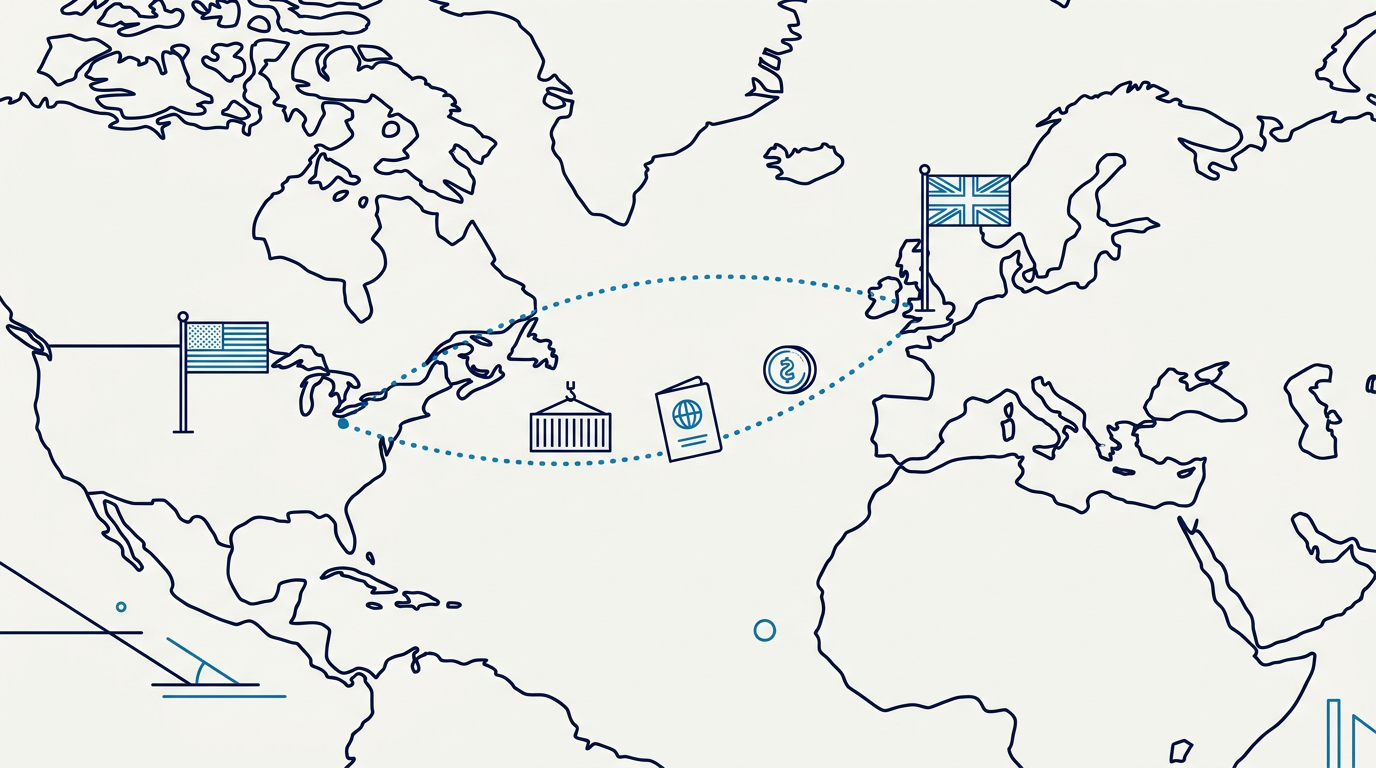
International expansion gets planned around the exciting parts, the new market, the new revenue, the new logo on the website. The actual headaches, the ones that genuinely slow a business down or cost it real money, almost never show up in that part of the plan. They show up in the operational detail nobody thought to ask about until it was already a problem.
The part everyone plans for
Market research, pricing strategy, who the competitors are, whether there's demand. This is the part that gets a proper plan, usually correctly, because it's the part that feels like the actual decision. It's rarely where expansions actually go wrong.
The part that quietly causes the real damage
Freight and logistics into a new country is one of the most underestimated pieces of an expansion, and it connects directly to everything that makes freight difficult in the first place: rates, capacity, and relationships that don't exist yet in the new market. A business that's spent years building freight relationships domestically starts an international expansion with none of that goodwill, and pays for it in exactly the moments it matters most, a customs delay, a capacity crunch, a shipment that needs prioritising.
Tariffs add another layer most businesses don't plan for properly. Some are charged as a flat rate per unit or per kilogram, but most manufactured goods are charged as a percentage of what was paid for them, and it's rarely just one rate. A single shipment can be subject to a base duty, plus one or more additional tariffs layered on top for the same goods, calculated on the same value, stacking rather than replacing each other. None of this is fixed either. Rates and thresholds get revised, sometimes with very little notice, which means a landed cost that was accurate six months ago isn't a number to still be relying on today. Getting this wrong doesn't show up as a strategic failure. It shows up as a margin that was smaller than expected on every shipment, for reasons nobody traced back to the tariff structure until the pattern had already cost real money.
Regulatory and compliance gaps
Different countries mean different rules, on everything from product standards to employment law to how invoices legally need to be structured. None of this is exciting to plan for, which is exactly why it's the part most likely to get under-resourced. The businesses that get caught out aren't the ones that didn't know regulations existed. They're the ones that assumed "we'll figure it out once we're in market," which is a much more expensive way to learn the rules than finding out beforehand.
What this looks like in practice: expanding into the US
The US is the most common first stop for UK businesses expanding abroad, and it's a useful example precisely because the two countries feel similar on the surface. Same language, similar business culture. The cost structure underneath is not similar at all.
In the UK, the additional cost of employing someone, on top of salary, tends to land around 20-25%: employer National Insurance at 13.8% above £175/week, a minimum 3% workplace pension contribution, and 28 days statutory holiday including bank holidays. In the US, the same figure typically runs to 25-40%, and it is a different shape of cost entirely. There is no NHS to fund through payroll taxes, so healthcare becomes the employer's problem directly, averaging around $12,000 a year per employee and reaching $20,000-$25,000 in competitive sectors like tech. FICA adds 7.65% on wages (6.2% Social Security, 1.45% Medicare), on top of federal and state unemployment insurance that varies by state. There is no statutory paid holiday requirement at all; the market norm is 10-15 days plus holidays, and a business offering the UK-equivalent 28 days would be well above what's expected. Sick pay and parental leave follow the same pattern: no federal baseline, then a patchwork of individual state rules that vary depending on exactly where an employee is based.
VAT causes a similar shock in reverse. UK VAT is one system, collected in stages, with credits for VAT already paid on inputs. US sales tax is collected once, at the final sale, but it is not one system, it is thousands of them: state, county and city rates stacked on top of each other, with some states charging none at all and others adding local surtaxes on top of a state rate above 7%. A business trading in several states can find itself registering and filing separately in each one, and since the 2018 Wayfair Supreme Court ruling, a business can owe sales tax in a state purely because of how much it sells there, typically once it passes around $100,000 in revenue or 200 transactions, even with no physical presence at all.
None of this makes US expansion a bad idea. It makes it a different cost base and a different compliance load than the UK one it's being compared against, and that's exactly the kind of detail that needs confirming before committing, not after.
The systems that don't travel
A business's internal systems are usually built around how the domestic operation actually works: its currency, its tax structure, its reporting cycle, its customer support hours. International expansion exposes every assumption baked into those systems at once. Invoicing in a second currency, supporting customers in a different time zone, reconciling accounts across two regulatory environments, all things that worked fine when there was only one country to think about, and all things that start generating quiet, expensive friction the moment there's a second one.
The most common version of this is fragmentation: payments, tax compliance, logistics and returns each running on their own separate system, none of them built with a second country in mind. On their own, each gap is manageable. Together, they turn what should be a straightforward rollout into one held up by manual workarounds, and a project planned for weeks quietly stretches into months while someone reconciles the same shipment across three different systems by hand. Customers feel it too, usually as checkout friction or a returns process that's slow, confusing, and expensive to run across a border, which does nothing for loyalty in a market a business is still trying to win.
The pattern worth noticing
Almost none of the genuine headaches in an international expansion come from the market itself, whether people want to buy what you're selling. They come from the operational plumbing underneath it: freight, tariffs, compliance, systems, that nobody stress-tested before committing. What makes the pattern worth noticing is that these things compound rather than sit side by side. A freight relationship that doesn't exist yet makes a customs delay worse. A tariff structure nobody modelled makes a thin margin thinner. A system that doesn't reconcile across currencies makes a compliance gap harder to even spot, because nobody's looking at clean numbers in the first place. The market research tells you if there's an opportunity. It rarely tells you if the business is actually built to serve it yet, and by the time that gap shows up, it's usually already expensive.
What's worth doing before committing
A proper look at what breaks operationally, not commercially, when a second country gets added. Freight and logistics capability in the new market specifically, not assumed from the domestic relationship. Regulatory requirements confirmed in detail, not assumed to be similar enough. And systems checked against the actual demands of running two markets at once, not just one with a different flag on it.